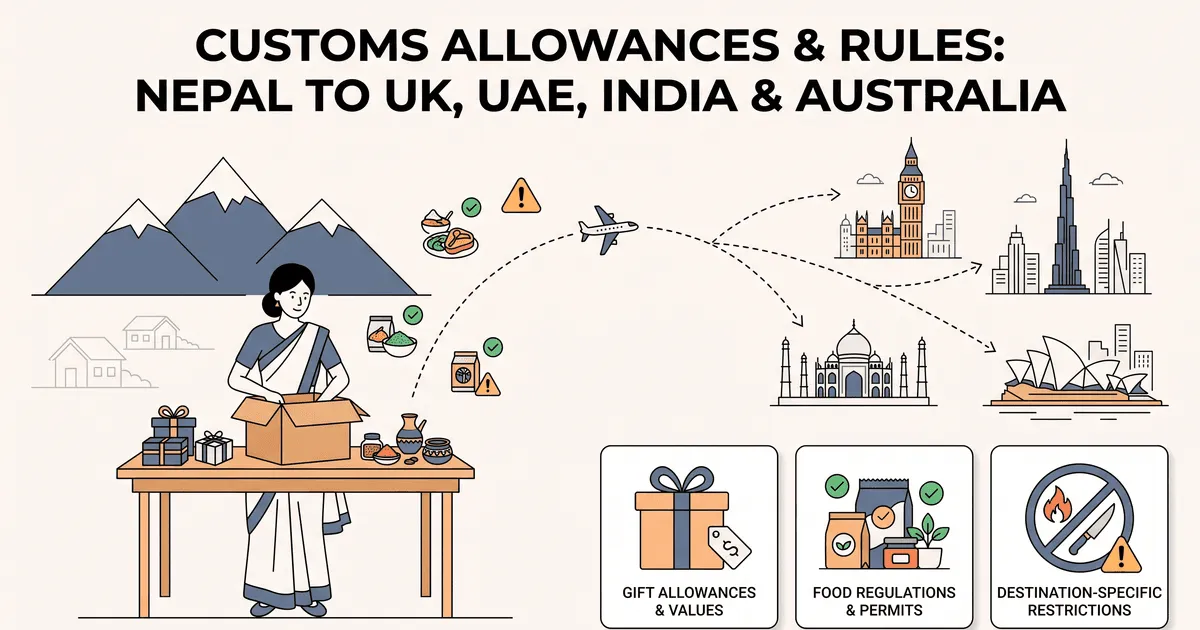
What a courier from Nepal will actually carry depends on where it’s going, and the answer changes more than most senders expect. A parcel that clears easily to Australia can be seized outright in the UAE for the exact same item. There’s no single “what can I ship from Nepal” answer — there’s one answer per destination, and this guide walks through the four corridors Nepal ships the most: the UK, the UAE, India and Australia.
Two sets of rules apply to every shipment, and they’re independent of each other. Nepal’s own export restrictions apply no matter where the parcel is going — no cash or currency, narcotics, weapons and explosives, counterfeit goods, or protected wildlife products; our guide to what you can’t ship from Nepal covers that side in full. This guide covers the other side — what changes once the parcel actually lands, because that’s where the real variation sits.
Sending to the United Kingdom
Most things a Nepali family wants to send to the UK travel fine — clothes, winter wear, pashmina, dhaka topi, packaged biscuits and namkeen, sealed pickles, handicrafts, small household items, gifts, and documents. Food is where parcels usually get stopped: raw meat, fresh fish and dairy are most likely to be refused or destroyed on arrival. Sealed, packaged items — biscuits, jarred pickle, dried spice — are the safer bet, but check with your vendor before packing any food, since couriers add their own rules on top of the government’s.
The UK gives a real gift allowance. A genuine gift between individuals, sent person to person and tied to a real occasion, skips import VAT and duty under a set value threshold set by HMRC. Above it, VAT applies, and past a higher threshold, Customs Duty stacks on top. Writing “gift” on a commercial shipment doesn’t qualify it — customs goes by the declaration, not the label. Whatever’s owed is billed to the recipient in the UK, not the sender.
Nepali-origin handmade textiles — pashmina especially — may qualify for a lower or zero duty rate under a UK trade scheme for developing countries, but it needs a certificate of origin arranged at export, not claimed after the fact.
Sending to the United Arab Emirates (Dubai)
Beyond meat, the categories to avoid are media and printed material that conflicts with local law and cultural norms, anything narcotic, weapons, and counterfeit goods. Everything else in a typical Gulf-bound family parcel is generally fine: clothes, packaged snacks, dried fruit, biscuits, commercially sealed achar, spices in their original labelling, handicrafts, small household goods. The recurring problem isn’t the item, it’s the packaging — an unlabelled container of something homemade gives customs nothing to identify it by, and that’s what gets it set aside.
Personal-use items and genuine gifts under a set value are generally exempt from customs duty in the UAE without a formal declaration below that threshold. Above it, the recipient in Dubai is typically liable for a small import duty plus VAT on delivery — not the sender at booking.
Some medicines that are ordinary over-the-counter items in Nepal are controlled substances in the UAE and need prior approval before they can be sent. Check current UAE Ministry of Health and Prevention guidance for the specific medicine before you pack it.
Sending to India
Clothes, packaged and shelf-stable food, books, documents, electronics for personal use, handicrafts and general household items all travel on this corridor routinely.
Unlike the UK, which relieves genuine gifts under a set value, and the UAE, which allows a personal-use allowance, India generally does not exempt a parcel from duty just because it’s low in value or labelled as a gift. Plan on your recipient being billed rather than hoping the word “gift” on the form does the work.
Seeds, plants and homegrown produce are worth calling out separately. The open border makes people assume a packet of seeds or a sapling travels the way it would between two districts of Nepal — it doesn’t. Agricultural goods generally need a phytosanitary certificate, and without one, confiscation at the border is the stated risk.
Sending to Australia
Depending on the courier and Australian import requirements, you can generally send clothes and winter wear, biscuits and packaged foods, pickles and achar, gifts, personal and household items, and documents and certificates.
A gift is priced and inspected exactly like anything else — Australian customs assesses what’s inside the box, not the occasion. Declare the actual contents item by item rather than writing “gift” on the form; vague declarations are what get parcels opened for inspection. Give each item a real value, since understating it caps what you can claim if something goes wrong, and a nil declaration just invites customs to set their own figure.
The declaration matters more than the item
Across all four corridors, the pattern repeats: a vague declaration causes more holds than most restricted items do. “Gift” and “personal items” tell an inspector nothing. Listing the actual contents — “cotton pashmina shawl, 1 pc, NPR 3,500” instead of “gift” — is what keeps a parcel moving. If you haven’t sent internationally before, how to send a parcel abroad from Nepal covers the declaration in more depth, and who pays customs duty on a parcel from Nepal covers what happens with the bill once it’s assessed.
Can I send sukuti or dried meat from Nepal to Dubai?
No. Meat and meat-based products, including dried meat such as sukuti, are prohibited in courier shipments to the UAE, and a shipment found to contain any is at risk of being seized in full — not just the meat, but everything packed around it.
Does the UK exempt gifts from customs duty?
Only genuine gifts. A gift sent person to person, declared as a gift, and tied to an occasion skips import VAT and duty up to a threshold set by HMRC; above that, VAT applies, and Customs Duty kicks in past a higher threshold. Writing "gift" on a commercial shipment does not qualify it.
Do I have to pay customs duty on a gift parcel sent to India?
Most likely yes, at least in part. Unlike the UK and the UAE, India does not generally exempt low-value or gift-labelled parcels from duty — imports are usually assessable regardless of declared value or occasion.
Can I send food to Australia from Nepal?
Sealed, commercially packaged food generally travels, but Australia applies strict biosecurity scrutiny to food, plants, animal products, seeds and medicines. Declare contents accurately — an incorrect declaration is what causes delays and inspection.
What items are banned from every destination when shipping from Nepal?
Nepal's own export rules apply regardless of destination: no cash or currency, narcotics, weapons and explosives, counterfeit goods, or protected wildlife products. Each destination country then adds its own import restrictions on top.
- #customs rules nepal
- #what you cannot ship from nepal
- #customs duty
- #send parcel abroad
- #international shipping